The scope of programs at the Toronto Hemingway conference was typically varied and often surprising. Attendees one night got a welcome from the editor-in-chief of the Toronto Star, Hemingway’s erstwhile employer, about which we’d hear several different takes. In several days of panels, subjects included Hemingway and religion (many conflicting ideas and interpretations); Hemingway and boxing; artificial intelligence, including a video production of The Old Man and the Sea that features a voice clone (yuk) as narrator and triggers all the right questions about permissions and consent; Hemingway and the American West, as we’ll see in a forthcoming collection of essays prompted by our 2022 conference in Wyoming; and the Canadian journalist and writer Morley Callaghan, whose most significant claim to fame came not from his literary publications but from the quite memorable Paris boxing episode, witnessed by F. Scott Fitzgerald, in which he bopped Hemingway’s nose.
Two panels separately previewed two volumes of the formidable Hemingway Letters Project, one coming in 2027, from Cambridge University Press, and one maybe two decades later (explanation below). The Letters Project, which launched in 2002 under the general editorship of Sandra Spanier, of Pennsylvania State University, aims to publish more than 6,000 known letters in at least 17 volumes, all carefully prepared, superbly introduced, and helpfully annotated. Over the years I’ve written and/or reviewed at least three of the collections as they progressed through the remarkable life, the incessant travels, the self-obsessed manias, and the multiple Hemingway personae his correspondence reveals.
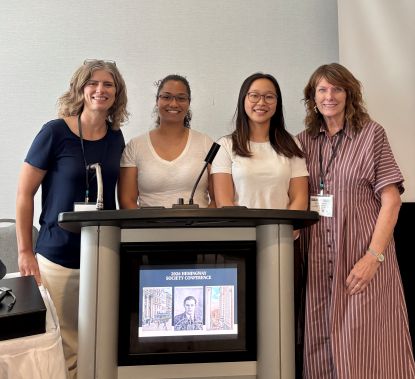
Volume 7 of The Letters of Ernest Hemingway, edited by Verna Kale, president of the Hemingway Society, and Miriam Mandel, a specialist in Hemingway’s Spanish experience, will span the summer of 1936 to early 1940. It roughly encompasses Hemingway’s four transatlantic trips to cover Spain’s Civil War plus the dissolution of his second marriage (to Pauline Pfeiffer Hemingway), his affair with future wife number three Martha Gellhorn, and the writing of the epic war novel For Whom the Bell Tolls. Alex Vernon, a Kansas City native who teaches at Hendrix College in Arkansas, provides the volume’s introduction, largely from his perspective as a scholar of the Spanish war.
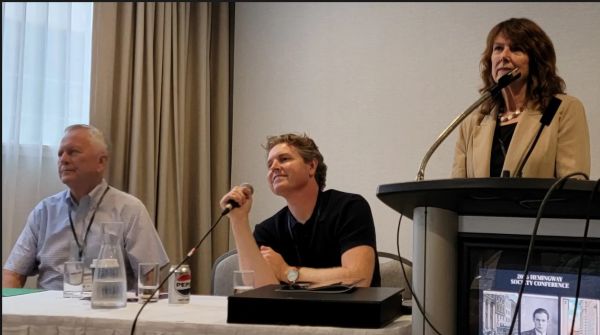
The other preview involved volumes 17 and, likely, 18, covering Hemingway’s last four years, up to his suicide in July 1961. It’s due for publication at least two decades down the road, but the work is already under way because it benefits from the editorial assistance of Valerie Hemingway. She was a key member of Hemingway’s circle in those final chapters of his life. Indeed, and given the death last fall of Hemingway’s son Patrick (born in Kansas City in 1928), she’s one of that circle’s last living members.
As an 18-year-old budding journalist from Ireland, Valerie Danby-Smith joined a Hemingway entourage in Spain in 1959 and became the writer’s secretary before becoming his posthumous daughter-in-law a few years later. The fact that she took Hemingway’s dictation, typed many of these letters, and helped organize his papers while working with Hemingway’s widow made Valerie a natural team member for the Hemingway Letters Project.
Valerie was unable to attend the conference, but, from her home in Bozeman, Montana, she sent a video discussing her memories and observations. Hemingway actually gave her the most routine letters requiring perfunctory answers to handle on her own. But typically he sat on a wicker chair in the library of his Cuban hilltop home and spoke aloud his replies to friends, relatives, editors, and strangers alike as she took notes. “My misspelling did not earn demerits,” she said. In some extreme cases, letters were never sent, she said, and were meant to get the anger out of his system; it was how he dealt with his “errant temper.” Yet, she said, the letters find Hemingway, as they have all along, discussing a vast range of topics. “There was hardly any aspect of life that didn’t interest him.”
Until now I was unaware that publisher Charles Scribner had given Valerie an office in order to further organize the Hemingway papers in preparation for Carlos Baker’s landmark biography, which Scribner’s would publish in 1969. (A research digression: It was amusing to discover recently, in a letter to his onetime step-mother Martha Gellhorn, that Patrick referred to the biographer as “Careless Baker.”)
This letters panel also included tantalizing presentations by the volume editors, Michael Von Cannon (on the fraught relationship between Hemingway—including wife Mary—and the photographer Yousef Karsh) and Jerry Kennedy. Poignantly, Kennedy, of Louisiana State University, recapped a major thread running through the 750 letters of those years—that being Hemingway’s long decline in mental and physical health.
Hemingway was well aware of his mortality, of his own unraveling, as Kennedy put it. Kennedy revealed two little-known and quite revealing items relating to Valerie. It’s no surprise, as Mary Hemingway suspected, that Hemingway had strong feelings toward the young woman, but in one lonely letter from Hemingway to her, he writes, “I’ll think about how you sound when you say ‘we.’”
The other notable item was a note Hemingway sent to A.E. Hotchner, a friend and legacy gadfly, which included a check, apparently for $1,500, intended for Valerie. Until this project came around, she maintains, she never saw the letter or the check. Many questions thus arise, which, at this point and especially 20 years from now, may have no adequate answers.
To be continued
Steve Paul is now retired after more than 40 years at the Kansas City Star, where he became the editorial page editor and columnist. He is the author of Hemingway at Eighteen: The Pivotal Year That Launched an American Legend (Chicago Review Press, 2017) and Literary Alchemist: The Writing Life of Evan S. Connell (University of Missouri, 2021), which received the best biography/memoir award (2022) from the Society of Midland Authors. He edited Kansas City Noir (Akashic, 2012) and co-edited War + Ink: New Perspectives on Hemingway’s Early Life and Writings (Kent State, 2014), an essay collection which emerged from the 2008 Hemingway Society conference in Kansas City, which he co-directed with Gail Sinclair and Steve Trout. His current project, a biography of the great 20th-century American poet William Stafford, is slated for publication by Oregon State University Press in 2027.