Editor’s Note: The letters described in this series of blog posts were purchased by Taylor Kirkpatrick from a member of the extended Hemingway family. They will appear in future volumes of The Letters of Ernest Hemingway, the comprehensive scholarly edition of Hemingway's letters being published by the Hemingway Letters Project. (The text of the letters themselves cannot be published on the blog at this time because of American copyright law.) Because the letters are privately owned and not yet publicly available for scholars to access at this time, the Society determined that The Hemingway Review blog, rather than the Hemingway Review, is the most appropriate venue for the publication of this information.
Hemingway as Father: A New Portrait from the Letters
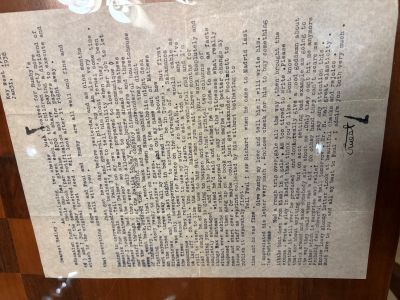
The most transformative contribution of the Hadley Richardson letters is their sustained portrayal of Hemingway as a father deeply engaged in his son’s development. Across the correspondence, Hemingway attends closely to Bumby’s education, discipline, physical talents, emotional health, and moral formation.
In January 1939, after seeing Bumby in New York, Hemingway reports with unmistakable pride that the boy was “looking and acting marvellously [sic],” working hard in school, and approaching his examinations with seriousness and composure.6 This pride is consistently tempered by vigilance. Hemingway repeatedly expresses concern about the dangers of indulgence, distraction, and moral drift, particularly in academic settings where parental supervision is attenuated.
By April 1942, as Bumby attended Dartmouth, Hemingway’s letters reveal a father preoccupied with the ethics of independence. In a lengthy and carefully reasoned letter, he insists that “the only discipline that can be imposed on him is through him having only so much to spend per month,” arguing that unrestricted access to funds would undermine both responsibility and character.7 The tone is neither authoritarian nor indulgent; rather, it reflects a considered philosophy of parenting grounded in experience and self-critique.
Equally revealing is Hemingway’s engagement with Bumby’s physical talents. He encourages fishing, shooting, tennis, and later boxing—not as performances of masculinity, but as arenas for discipline, confidence, and earned competence. In a detailed June 12, 1942, letter, Hemingway recounts Bumby’s success in Cuban shooting competitions, praising his “good nerves,” “marvelous reflexes,” and “very fine eyes,” while emphasizing that the money Bumby earned came from skill rather than allowance.8 The lesson is explicit: competence precedes reward.
Perhaps most striking is Hemingway’s insistence on writing as moral discipline. He repeatedly urges Bumby to write letters regularly, framing communication as accountability. “The strongest factor that will keep him from doing careless and irresponsible things,” Hemingway explains, “is if he has to write and tell about them.”9 This emphasis on articulation, reflection, and self-reporting challenges the stereotype of Hemingway as hostile to introspection or verbal intimacy, instead revealing a man deeply concerned with his son’s well-being. A letter to Hadley dated April 24, 1942 outlines this concern even further: “I was very happy to get your letter about Bumby and see how well you had arranged everything. It only makes me worry when I don't hear, and now I have heard and everything is fine.”
Yet these demonstrations of paternal concern must be weighed against patterns of absence and inconsistent communication. Hemingway's September 15, 1942 letter to Hadley admits he has "not heard align from him since he left here last June"—a silence of over three months. The financial vigilance and moral instruction documented in these letters occurred largely at a distance, mediated by correspondence rather than sustained daily presence. The letters thus reveal not simple devotion, but the complex negotiations of a father attempting to maintain authority and connection while pursuing work and adventure elsewhere.
Taken together, the letters reveal a father who is attentive, anxious, proud, and reflective, far removed from the caricature of emotional absence that has often dominated Hemingway biographies.
To be continued . . .
Notes
6 Ernest Hemingway to Hadley Richardson, April 8, 1942.
7 Ernest Hemingway to Hadley Richardson, June 12, 1942.
8 Ernest Hemingway to Hadley Richardson, June 12, 1942.
9 Ernest Hemingway to Hadley Richardson, January 31, 1938.
Taylor Kirkpatrick is a Denver-based collector and independent scholar whose Hemingway collection spans correspondence, manuscripts, photographs, and first editions documenting the writer’s development and personal relationships. Highlights include letters and books inscribed to Hadley Richardson and an archive of Hemingway’s friendship with Lillian Ross. His forthcoming 2029 exhibition at New York’s Grolier Club draws on the collection to explore Hemingway’s private life and literary identity. He chairs the board of Arion Press in San Francisco and serves on the Smithsonian Libraries and Archives Advisory Board.
Miranda Popp is co-director of Creative Writing at Denver School of the Arts and a National Board Certified Teacher. Her teaching and curriculum development span creative writing, AP Literature, LGBTQ+ literature, and film studies. She studied English and secondary education at the University of Colorado Colorado Springs, with a minor in philosophy.