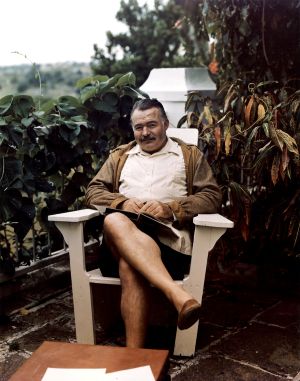
My first visit to Finca Vigía was in August 1998. I was seven years old, and like many Cuban children visiting the museum for the first time, I was captivated by what surrounded me: thousands of books, hunting trophies, paintings, and the strange feeling that Hemingway might walk through the door at any moment.
Years later, I returned not as a visitor but as a museologist. For four years I worked inside the house, arriving before the first visitors each morning, walking through its quiet rooms, caring for its collections, and answering the questions of people who had traveled from around the world in search of “the real Hemingway.”
Every day I encountered the same objects, yet gradually I began to look beyond the collections themselves. It was not one object that prompted this question; it was the Finca itself that made me wonder whether Finca Vigía mattered simply because Hemingway had lived there, or because of what had happened to him there.
Only later, while reading anthropology, did I finally find a language for that intuition: the concept of liminality, first introduced by Arnold van Gennep and later developed by Victor Turner. Van Gennep described liminality as the middle stage of a rite of passage, when an individual has left one social status but has not yet entered another. Turner expanded the idea, seeing liminality as a space of possibility where new ideas and relationships can emerge. Suddenly, the house no longer appeared to me as merely a preserved writer’s residence. It became something else: a threshold where identities could be reshaped and lives redirected.
Even its geography suggests an in-between world. Situated on a hill in San Francisco de Paula, Finca Vigía stood between Havana and the countryside, between solitude and sociability, and between Cuba and the United States. But its liminality was not only geographic. The Finca was a residence, a social space, and a place of discipline work, allowing Hemingway to move between retreat and connection with the outside world.
Hemingway himself explained why he remained there in a letter to Earl Wilson: "Find me a place in Ohio where I can live on top of a hill, be fifteen minutes from the Gulf Stream, grow my own fruits and vegetables the year around, raise fighting cocks without breaking the law, and I'll go live in Ohio if Miss Mary and my cats and dogs agree." Elsewhere, he offered a simpler reason: in Cuba, "in the cool of the morning you work better and more comfortably than anywhere else."
Those mornings mattered.
After the disappointing reception of Across the River and into the Trees, many critics believed Hemingway’s best work was behind him. Yet Finca Vigía offered the quiet, the routine, and the discipline that allowed him to regain his creative confidence. It was there that he wrote The Old Man and the Sea, the work that restored his international reputation and led to the Pulitzer Prize and, soon afterward, the Nobel Prize.
Looking back, I realize that I was never simply working in Hemingway’s house. I was working inside the space where one of the most significant transformations of his life unfolded. That realization became the foundation of my research and continues to shape the way I understand Finca Vigía today. It was more than Hemingway’s home. It was a house between worlds, where, after years of uncertainty, he found his way back to himself as a writer.
Massiel Pita graduated with a B.A. in History from the University of Havana. She worked as a museologist at the Ernest Hemingway House Museum, Finca Vigía, San Miguel del Padrón, Havana, Cuba between 2018 and 2022. She has presented at the 18th International Colloquíum dedicated to Ernest Hemingway and the virtual conference of the Florida Hemingway Society in 2026. Her essay “The Female Representation of the New Woman in the Works Fiesta [The Sun Also Rises] and A Farewell to Arms by Ernest Hemingway” was published by the magazine La Jiribilla in June 2021, and her article, "The New Woman in Hemingway: Brett Ashley, Catherine Barkley, and the Crisis of Gender After World War I,” was published on June 24, 2026, by the Ernest Hemingway Foundation of Oak Park on its blog, A Moveable Read. She is Director of Cuban Affairs at the Florida Hemingway Society and Advisor to the Ernest Hemingway Historical Literary Movement of Miami, where she currently lives.