On September 1, 2026, the Academy of Natural Sciences, affiliated since 2011 with Drexel University in Philadelphia, announced it would be closing its doors on September 30, 2026. Founded in 1812 and opening to the public in 1828, the Academy is the oldest natural science research museum in the U.S., housing a collection of more than 19 million items that are accessible to researchers, educators, and to the public through the museum's exhibits.
Due to the Academy’s long history of operation, its collections and displays are valuable not only as specimens but as artifacts, part of the history of science: the dinosaur fossils, taxidermied animals, and pinned insects reflect an era when the study of nature was heavily oriented around the curation and collection of living creatures. The Academy funded many expeditions to collect specimens and fostered strong relationships with avid outdoorsmen to help expand its holdings, and one of its most notable collaborators was Ernest Hemingway.
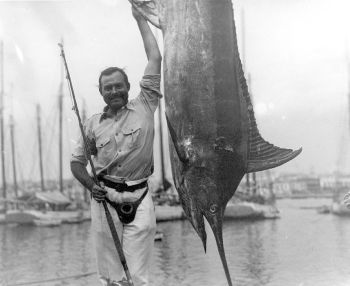
On March 6, 1934, Charles Cadwalader, the managing director of the Academy of Natural Sciences, wrote to Hemingway requesting his assistance with “securing additional information concerning the large game fish,” with the purpose of advancing scientific knowledge and a possible publication of a book. Hemingway, who had become an avid big game fisherman since he first arrived in Key West, Florida, in 1928, was already building a reputation as an authority on the subject. Cadwalader described the new project:
"Mr. Henry W. Fowler, our ichthyologist, realizing lack of knowledge concerning the classification, life histories, food, migrations, etc. of the sailfish, marlin, tunas and other large game fishes, is anxious to secure specimens and information in order that our knowledge of these fish may be advanced. We have great difficulty in securing specimens or even good photographs of these fishes."
Hemingway replied on April 2, 1934, stating “I would be very happy to Co-operate with you in any way” (Letters vol. 5, 584). “I believe we could get a complete collection of the Marlin or spearfish from the North Cuban coast,” Hemingway wrote. “It would be very interesting to have a complete collection of these fish and determine scientifically which are truly different species and which are merely sexual and age variations of the same fish. No one has studied them as they should be studied.”
Fascinated by these fish, Hemingway was eager for the opportunity to study them closely and to do work that had a broader scientific impact. Hemingway visited the museum briefly on the afternoon of April 9, 1934, while en route home to Key West from New York.
A few months later, Cadwalader and Fowler would join Hemingway on board his new boat, the Pilar, during July and August 1934, fishing the waters surrounding Cuba to help collect and measure specimens for the Academy’s archives and to study the marine ecosystems.
Throughout the excursion, Hemingway and the scientists targeted marlin. Hemingway was fond of Cadwalader and Fowler, affectionately dubbing them the “Scientificos, very good guys,” in an August 13, 1934, letter to Archibald MacLeish, claiming they “agree completely with my marlin theories” (Letters vol. 6, 35-7). In his first piece for Esquire magazine, Hemingway had asserted his theory that the “many color variations” found in marlin were “color and sexual variations of the same fish” (“Marlin off the Morro: A Cuban Letter,” Autumn 1933, 39). Reflecting on the fishing excursion with Hemingway in an August 28, 1934, letter to Morgan Hebard, Cadwalader wrote that “Fowler […] with Hemingway’s excellent knowledge of these fishes and their habits, etc., was able to secure enough information in order that he may revise the classification of marlin insofar as the Atlantic Ocean goes.”
Hemingway continued to write to Cadwalader and Fowler throughout the next year. In one letter from Hemingway to Fowler of October 9, 1934, Hemingway described the specimen he was sending them, salted and on ice, as a “small tuna shaped fish that looks, from length, of fin to be, possibly, an albacore.” In case it was not a good sample, Hemingway also sent Fowler cooking instructions: “If you dont want him as a specimen and he gets there in good shape wash the salt out, cut the meat off both sides of the back bone and broil it. Or cut the head off, make scores in the side of the fish and bake it” (Letters vol. 6, 83-4).
Recognizing Hemingway’s contributions to the Academy’s scientific efforts, Fowler named a newly discovered sculpin after him, Neomerinthe hemingwayi, writing in the Proceedings of the Academy of Natural Sciences of Philadelphia that the description was to recognize “Ernest Hemingway, author and angler of great game fishes, in appreciation of his assistance in my work on Gulf Stream fishes,” and thus etching Hemingway’s name into the annals of scientific history, even if he played a small role (Letters vol. 6, 322 n. 1).
As for Hemingway’s writing during his period of fishing mania, from 1934 to 1936, his public-facing writings in Esquire magazine helped to cement him as an authority on big game fishing. Retrospectively, Hemingway and big game fishing are synonymous, but in the 1930s, this was a radical shift in how novelist, fly fisherman, and bull fight aficionado Hemingway portrayed himself. This move had his editor, Maxwell Perkins, a little worried. In his October 6, 1934 letter to Hemingway, Perkins warned him, “For God’s sake don’t get to be too much of a naturalist or you won’t have time to write.” “It’s fine you got into touch with those museum people,” Perkins continued, “if only they don’t get you to do too much for them.”
Despite Perkins’s trepidation, as Verna Kale notes in her Introduction to the Letters vol. 6, “Hemingway’s writing and fishing were bound together, serving each other,” giving him the experiences necessary to tell new tales and stay in the public eye for his high sea adventures (liii). Scientific and naturalistic pursuits helped to feed Hemingway’s turn to non-fiction in the 1930s, with works like Green Hills of Africa (1935) that chronicled Hemingway’s adventures in nature. Perhaps Hemingway himself recognized this when he wrote to Perkins to have an advance copy of Green Hills of Africa sent to Cadwalader (Letters vol. 6, 356).
While his correspondence with Cadwalader and Fowler ended after 1935, specimens collected by Hemingway and company--and his letters and photos--still reside in the Academy’s collections, providing valuable resources for researchers and materials for educators teaching students about natural history and scientific practices.
As the Museum of the Academy of Natural Sciences prepares to close, it is worth meditating on how the museum functions as a chronicle of scientific methodologies. When Hemingway was a collaborator, best practices centered around collecting and curating samples, but this is no longer the way natural history museums educate people, given environmental and ethical concerns of this kind of curation. Hemingway wanted to be a layman pioneer in science, and working with Cadwalader and Fowler gave him this opportunity, but it also reflected an approach to research based around experiencing nature firsthand--in a way, this was a democratic approach to science, because science was just outside the volunteer naturalist’s front door.
By closing its doors, the museum is abandoning not just its present-day collections, but its history that Hemingway helped to shape, a long history centered around marvel, wonder, and awe at how the experience of being in nature can transform lives.
Works Cited
Cadwalader, Charles to Ernest Hemingway, letter, 6 March 1934. Academy of Natural Sciences, Philadelphia.
Cadwalader, Charles to Morgan Heberd, letter, 28 August 1934. Academy of Natural Sciences, Philadelphia.
Hemingway, Ernest. The Letters of Ernest Hemingway: Volume 5, 1932-1934. Edited by Sandra Spanier and Miriam B. Mandel, Cambridge UP, 2020.
--. The Letters of Ernest Hemingway: Volume 6, 1934-1936. Edited by Sandra Spanier, Verna Kale, and Miriam B. Mandel, Cambridge UP, 2024.
--. “Marlin off the Morro: A Cuban Letter.” Esquire, Autumn 1933, pp. 8-9, 39, 97.
Perkins, Maxwell to Ernest Hemingway, letter, 6 October 1934. Ernest Hemingway Personal Papers, John F. Kennedy Presidential Library and Museum, Boston.
Ryan Bohn is a graduate student at the Pennsylvania State University, researching nineteenth and twentieth century American literature. He serves as a research assistant on the Hemingway Letters Project. His article "Immigrant Consciousness and Postmemory in the Short Stories of Sui Sin Far" was published in the South Atlantic Review in June 2026.