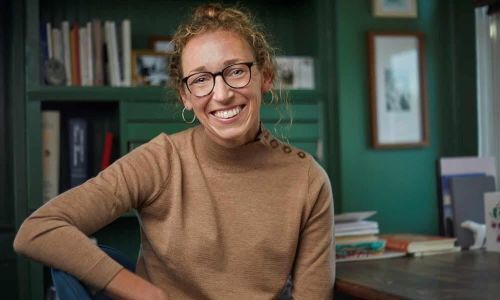
Since 1976, the PEN/Hemingway Award has honored a debut novel of exceptional merit by an author who has not previously published a full-length work of fiction. The purpose of the award is to champion new voices of promise entering the literary landscape. Winners receive a cash prize of $10,000 and a residency in support of the development of new work from the Ucross Foundation. The Award is presented at an annual ceremony held at the John F. Kennedy Presidential Library and Museum in Boston.
The 2026 winner of the PEN/Hemingway Award was Virginia Evans for her novel The Correspondent. This year's finalists were Susanna Kwan for her novel Awake in the Floating City and Maggie Su for her novel Blob: A Love Story. The authors of the three finalist books were honored at the 50th Annual PEN/Hemingway Award Celebration on April 26, 2026.
Q: Do you remember when you knew you would be a writer?
A: I think I knew I would be a writer when I was in high school. I happened to get in an honors English class (it was probably a fluke), and I read The Grapes of Wrath by John Steinbeck. I had always been a reader, but not of elite things. I read The Grapes of Wrath and I was so moved by it. I thought, “I could do that.” It’s insanity to read The Grapes of Wrath and think, “I can do that”!
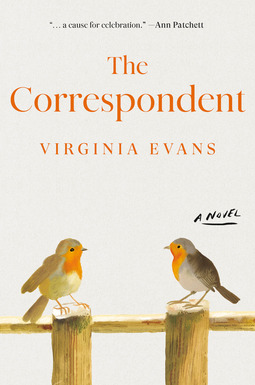
Q: You have said that you wrote seven unpublished novels before you published The Correspondent. What kept you going as a writer during those years?
I did self-publish one novel because I was in need of some cash!
Sometimes I think back and think, “Could I do that again? Trying and failing for so many years? Do I still have that in my tank?” But it’s the only thing I thought I could do. Publication wasn’t the motivation then. I was teaching myself everything. I would finish a book and think, “I can do better.” For so many years, the motivation was writing a better novel.
In my early thirties, I started to feel the ache of never reaching the finish line. Publication was the finish line. Part of what I was teaching myself was the process of publication. I didn’t know anyone who had published a book, and I didn’t know anyone in the world of publishing. I was starting from a place of total ignorance. How do I publish this? You need a query letter and an agent.
Initially I had The Correspondent out for sale, and no one was interested, and we needed money. I started researching going to law school, and within two weeks, Crown bought The Correspondent.
I just never thought of doing anything else. The motivation for me was always myself and “I think I can do better.” That’s why I keep writing books. I keep wanting to do better. It all goes back to reading Grapes of Wrath when I was 16 years old.
Q: You were raised in Severna Park, just outside Annapolis, Maryland. How did that place influence your writing?
I chose that place as the setting for The Correspondent because it felt so reachable, so easy for me to describe and understand. If I set it there, I didn’t have to worry about the setting: I understood the place; I understood the people; I understood the topography and the landscape. The presence of water was also really important to the story.
I’ve moved a lot as an adult, and we moved a lot when I was growing up. I’ve been a little bit of a nomadic person. I don’t have a strong sense of where I’m from. I don’t identify myself as being from there, but it is a part of the tapestry of who I am.
Q: Tell us about your graduate work at Trinity College in Dublin. Who there had the biggest impact on you?
The person who had the biggest impact on me at Trinity was Carlo Gebler. He’s a very well loved and respected Irish writer. He was one of my mentors in the program. He had mentored me in the craft of fiction but also in plumbing the depths of me and figuring out, “Where did that story grow out of in me?” It’s become a symbiotic relationship. He continues to read my work before it’s published and gives me feedback, and I read his and give him feedback.
It was also very influential to study under Claire Keegan. Her teaching on fiction was tremendous and a game changer for me as a writer. She teaches out of this place that is very influenced by Chekhov and very distilled and pure.
Eoin McNamee was my other mentor at Trinity. He was my advisor, and his influence and guidance with my work were also very meaningful.
Q: Do you remember who informed you about winning the PEN/Hemingway Award, and do you remember where you were when you received the news?
I was sitting in my car parked on the side of the street, going to get a haircut. It was a tough time, in the middle of moving out of one house, renovating another house, going on an extended book tour, and I had just found out my grandfather was very sick. Gwydion Suilebhan [executive director of PEN/Faulkner, which administers the award] called me, and I couldn’t respond. I just sat there crying.
I felt very exhausted with my life, and it was a very beautiful change to my day.
To be continued . . .
The PEN/Hemingway Award is supported by the Hemingway Foundation and Society, the PEN/Faulkner Foundation, the Hemingway Family, the Ucross Foundation, the John F. Kennedy Presidential Library and Museum, the John F. Kennedy Library Foundation, and the Friends of the Ernest Hemingway Collection. The members of the Hemingway Society support the award through their continued membership and through their donations. For more information about the PEN/Hemingway Award, visit this link to the website of the PEN/Faulkner Society, which administers the award:
https://www.penfaulkner.org/our-awards/the-pen-hemingway-award/