The previous entry of my report on the Hemingway Society’s 2026 Toronto conference concluded with scholar Jerry Kennedy’s perspective on Hemingway’s declining last years as seen through some 750 letters from 1957 to1961.
But there’s more to the story, as Kennedy recounted: In the late 1950s, Hemingway was at work on his Paris memoir, A Moveable Feast, and essentially finished it to his satisfaction, despite some opinions and a published alternative to the contrary. He had also amassed some 1,700 manuscript pages of a novel eventually called The Garden of Eden, though the memoir and two long Life magazine articles on the Spanish bullfight adventures of 1959 interrupted his progress. (The Garden of Eden manuscript exists in the Hemingway Collection at the John F. Kennedy Library in Boston—and untold scholars’ file drawers; it was published in a much-abbreviated edition in 1986, and because of its story lines of gender fluidity, the novel helped to ignite new academic interest in Hemingway among feminist, LGBT and general literary scholars. The Spanish pieces were repackaged as a posthumous book, The Dangerous Summer, in 1985.)
I couldn’t help but think again about how the white-bearded images of Hemingway in those years (including the famous one by Karsh of the writer in a turtleneck sweater) had become so familiar in the cultural terrain. It always seems startling to realize that he was hardly an old man when he took his own life in 1961—he was three weeks shy of turning 62.
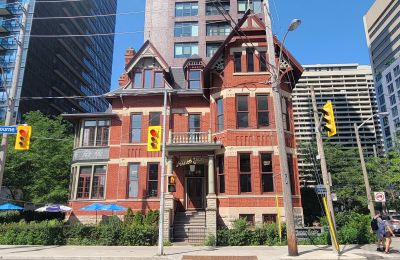
Much of the conference conversation involved Toronto’s connection to Hemingway’s earliest journalism and to the Canadian slices of his biography. When we brunched at Maison Selby, a fine French restaurant near Toronto’s Cabbagetown district, we were brushing up against the period in 1923 when he and wife Hadley returned from Paris, stayed at what was then the Selby Hotel, and awaited the birth of their son. John Hadley Nicanor Hemingway, familiarly known as Bumby and later in life as Jack, was born prematurely on October 10, 1923. Hemingway was incensed that he missed the occasion because he’d been sent on an unsatisfying assignment to New York. Within three months, Hemingway resigned from the paper, and the infant Bumby and his parents sailed (from New York) back to Paris and toward imminent literary history.
My own contribution to the proceedings had nothing to do with Canada. Instead, I examined the counter-intuitive occurrence of a handful of very long and superbly intriguing sentences—recall the reputation of minimalist and crisply etched short sentences—in Hemingway’s 1930s travel memoir Green Hills of Africa. This is another of Hemingway’s books freighted with the casual racism and colonialism of its day, but as the scholar Marc Dudley helpfully mentioned one day on a panel about Hemingway and boxing, the high points of Green Hills of Africa, especially the vivid writing, as I would be featuring, outweigh (from today’s perspective) its problems.
Mine was a small pebble in the always expanding Hemingway stream. Yet, these biennial conferences always remind us of the vibrancy and endlessly evolving perspectives on a writer we think we know so well but whose iceberg tendencies continue to demand further inspection.
Steve Paul is now retired after more than 40 years at the Kansas City Star, where he became the editorial page editor and columnist. He is the author of Hemingway at Eighteen: The Pivotal Year That Launched an American Legend (Chicago Review Press, 2017) and Literary Alchemist: The Writing Life of Evan S. Connell (University of Missouri, 2021), which received the best biography/memoir award (2022) from the Society of Midland Authors. He edited Kansas City Noir (Akashic, 2012) and co-edited War + Ink: New Perspectives on Hemingway’s Early Life and Writings (Kent State, 2014), an essay collection which emerged from the 2008 Hemingway Society conference in Kansas City, which he co-directed with Gail Sinclair and Steve Trout. His current project, a biography of the great 20th-century American poet William Stafford, is slated for publication by Oregon State University Press in 2027.