The smoke had blown past and the skies were mostly clear in Toronto the week we spent immersed in the life and work of Ernest Hemingway.
Housed at Toronto’s stupendously bustling Chelsea Hotel, this was something like the 10th biennial Hemingway conference I’d attended in one place or another on two continents. Over the years, as a journalist and beginning with the centennial event in Boston in 1999, I'd chronicled some of the conferences in various ways. Given the programs of simultaneous paper sessions, it’s impossible to provide a thorough overview without the benefit of teamwork or cloning, so my accounts tended to reflect my personal interests and highlights that happened to offer (to me) significant and surprising moments.
So what I offer here is more like a personal essay than an all-encompassing report. If I’ve left out mention of some participants’ brilliant papers or comments, please don’t take it personally, and for those who did not attend, please rest assured there was much more of interest that would have spoken to a wide range of Hemingway students, scholars, fans, and casual, literary tourists alike.
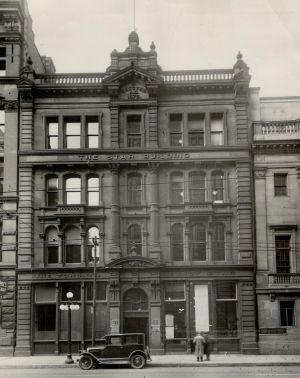
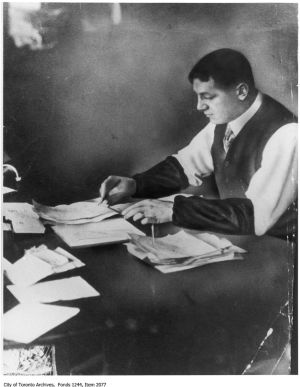
After beginning his professional journalism career in Kansas City in 1917-18 and surviving the blast of a mortar shell while serving in the Red Cross ambulance service in the “Great War,” Hemingway made off-and-on connections with Toronto as a resident journalist and a foreign correspondent. He didn’t much like the Canadian city, turned off largely by an imperious editor who failed to coddle Hemingway’s outsized ambitions.
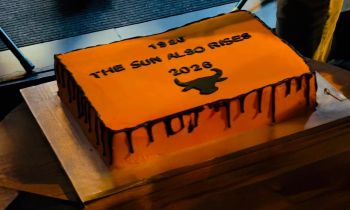
Among the main conference events were a celebration of the 100th anniversary of The Sun Also Rises, the novel that put Hemingway on the literary map and that has endured no small amount of contemporary resistance for its whiffs of antisemitism and youthful nihilism. The novel has entered the public domain, so the publishing possibilities have exploded, for better and for worse. There was a discussion among editors of five—count ‘em, five—recently published scholarly and teaching editions of the novel. (And coming very soon is the Library of America’s annotated and illustrated edition of the novel, edited by Robert Trogdon.) I’d encountered a couple of these good works before and picked up one that Debra Moddelmog, a longtime Hemingway scholar, edited for a Canadian publisher.
The apparatus accompanying Hemingway’s text in Moddelmog’s edition includes articles, reviews and other contemporaneous documents. One of those is a story Hemingway wrote for the Kansas City Star during his early journalism apprenticeship in the spring of 1918, about the U.S. Army’s recruitment efforts for its new Tank Corps. Coincidentally, in the multilayered proceedings of this academic literature conference, a British teacher, Joseph Wray, from a high school in Liverpool, explored the same obscure newspaper story, along with two other rarely visited Star articles, in a paper dealing with ideas of Hemingway, masculinity and eco-criticism (those tanks were destructive on the landscape!). Given his interest in the evidence
of the Kansas City period, I gave Wray a copy of my book, Hemingway at Eighteen.
Moddelmog, by the way, urges that readers understand The Sun Also Rises beyond the off-putting surface antisemitism, racism, sexism, and/or homophobia of its language and dialogue. “What if it’s illustrating how prejudice works?” she suggests. As she writes in a blog for the Broadview Press website, “My position is that the novel does not inherently accept prejudice but often demonstrates how prejudice operates, including its negative consequences, both on those who are its targets and on those who participate in its processes of stereotyping, ostracism, bullying, intimidation, exclusion, and violence.”
Moddelmog, a feminist scholar, professor emerita of the University of Nevada-Reno, and a board member of the Ernest Hemingway Society, hosted a social gathering one evening to honor the novel’s anniversary, complete with cocktails and celebratory sheet cakes.
To be continued . . .
Steve Paul is now retired after more than 40 years at the Kansas City Star, where he became the editorial page editor and columnist. He is the author of Hemingway at Eighteen: The Pivotal Year That Launched an American Legend (Chicago Review Press, 2017) and Literary Alchemist: The Writing Life of Evan S. Connell (University of Missouri, 2021), which received the best biography/memoir award (2022) from the Society of Midland Authors. He edited Kansas City Noir (Akashic, 2012) and co-edited War + Ink: New Perspectives on Hemingway’s Early Life and Writings (Kent State, 2014), an essay collection which emerged from the 2008 Hemingway Society conference in Kansas City, which he co-directed with Gail Sinclair and Steve Trout. His current project, a biography of the great 20th-century American poet William Stafford, is slated for publication by Oregon State University Press in 2027.