Some time later, we learned the story of when Hemingway first visited Finca Vigía. He saw a group of boys playing baseball in the street and asked them, “Why don’t you play inside?” — referring to the large open field on the property.
“We can’t. The dogs chase us away,” one boy replied.
And Hemingway answered, “I promise you that if I ever live on this estate, it will become the home of all the neighborhood boys.”
The last time we saw him remains vivid in my memory. We were standing near the swimming pool. He touched us on the head — including several girls who were with us — and said: “Write our story.”
“What story?” I asked.
“The mangoes, the cat, the guerrilla . . .” he answered.
Then he turned his back to us and walked toward the house, leaning on his long cane. He stopped, waved at us from a distance, and shouted: “Ah! And don’t forget to write about when you wet yourself. That will make you famous.”
One of the girls immediately repeated: “He says you wet yourself?”
Embarrassed, I said the first thing that came to mind to save my pride: “Don’t listen to him. That old man is crazy.”
“The American” told us he had to travel and that even if he wasn’t at the estate, we could still come in. And if they did not let us through the gate, we already knew how to get inside.
But that turned out not to be true.
After that day, they stopped letting us in. We still sneaked in sometimes.
But Hemingway never came back. We never saw him again.
When we learned of his death, we went to the estate, but this time we were not allowed inside as we had been before during his absences. When we insisted, several soldiers guarding the property told us that if we entered, we would be arrested.
Hemingway — “the American” — was an extraordinary neighbor in the town of San Francisco de Paula. There are many stories about sick neighbors whom Hemingway helped without hesitation, paying for medicine and medical expenses.
Yet how could a man who fished in the deepest and most dangerous Gulf Stream waters, hunted lions in Africa, survived multiple illnesses, car accidents, and two plane crashes — a man who lived through three wars (World War I, the Spanish Civil War, and World War II), and who was often described as a braggart — also possess such a gentle and humane side?
How could that same man spend his final years sharing mischief and adventures with children?
Today, more than half a century later, those neighborhood boys who once ran through the estate are now old men — some are no longer with us.
And when we stop to read Hemingway’s life and work, we realize that “the American,” within the refuge of Finca Vigía, was completely different from the man the world saw outside it.
And the world should know it.
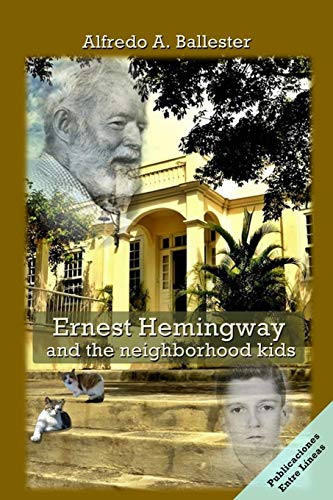
Alfredo A. Ballester is the author of Ernest Hemingway and the Neighborhood Kids, a book in which he recounts his personal experiences with “the American” — the celebrated American writer Ernest Hemingway — at Finca Vigía in Havana, Cuba. Born in Cuba, he now lives in Miami, Florida. He presented an earlier version of this blog post in Spanish, with an accompanying English translation, at the Florida Hemingway Society Virtual Conference on May 30, 2026.