In early 1976, my parents and I moved from a working class neighborhood in Southern Germany to a posh suburb of Hamburg. My new classmates were no longer the sons and daughters of accountants, pool attendants and workers at Daimler-Benz, but of lawyers, journalists and CEOs.
Our next-door neighbors, from whom my father had bought our plot, had three children. The elder son was a Communist who came home twice a year to fetch a big check to finance his revolutionary lifestyle. The daughter had married well and was into her third pregnancy. And then there was Joachim, ten years younger than his siblings and my age. He was a romantic rebel, a fanciful dreamer who wanted to escape the cage of his family’s wealth by leading an adventurous life. He was the most imaginative boy I ever met. And he was already an avid reader, which I, at sixteen, was not at all. Well, only if you count the works of Stan Lee.
We became friends on the first day we ever talked. He had what I lacked, charisma, and, as it turned out later, I had what he lacked: the ability to break free from parental expectations to lead an artistic life.
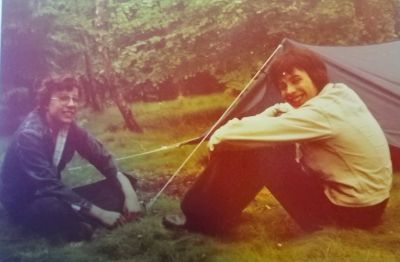
We discovered Hamburg together: the port, the whores of St. Pauli, the bars. We dreamt of becoming sailors. We dreamt of joining the Foreign Legion. We dreamt of going to Canada as lumberjacks. He gave me the books to go with this life: Jack London, B.Traven, Blaise Cendrars, and Hemingway.
That’s how I started my life of reading. One afternoon Joachim came over and tossed a handful of sheets on my desk, saying: "If you want to become a writer, you have to start with short stories." It was his handwriting and it was a story.
Up to that moment I hadn’t known that I wanted to become a writer. That changed then and there.
I reacted with a first story of mine about a boy getting into a storm with his sailing dinghy on Lake Superior. He capsizes but survives by holding on to a plank from the wreckage. I showed it to Joachim, who pointed out to me that there are no planks in these small polyester dinghies. So we decided that in our stories we’d better stick to things we knew about. Problem was, I didn’t know anything."
So I started to study Hemingway’s writing: "Write one true sentence." It was a school I loved and haven’t graduated from in 50 years. Not having any Gertrude Stein or Ezra Pound to teach me the state of the art, nor any Scott Fitzgerald to call my bluff, I made sluggish progress. But I made progress. In 1984, I still hadn’t deciphered Hemingway’s secret, but after writing 150 stories I had found my style and published my first collection.
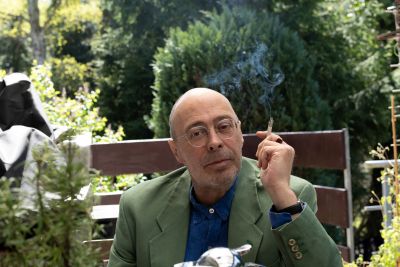
But as with everyone who gets into Hemingway’s gravitational field, it was not only his art of writing I was influenced by, but also his art and expertise of living well, of "utilizing," as Bill Gorton, Jake Barnes’s friend in The Sun Also Rises, put it. For years, I invariably ordered "Rioja Alta" in every restaurant, and to this day I proudly present the "true gen" about the right places to go and what to do there to my friends, whether they want to know or not.
Some time ago I informed my publisher that after years of writing novels, my next book would be another collection of short stories. I have always liked the short form alternating with more epic endeavors, having learned early in the Hemingway school that a short story can be just as much a work of art as any novel. Besides, I have the feeling that even more than novels, short stories perfectly accompany a writer’s evolution from youth to maturity through changing topics, changing approaches, changing sensibilities. (Compare in our time to "Black Ass at the Crossroads.")
On hearing the words "short story," my publisher’s face instantly fell. "What kind of stories are they supposed to be?" she asked with a yawn..
"Wel,l for one there is a story about Hemingway. About a week the very young Hemingway spent in Sicily, in Taormina, just after the war, in December 1918. And nobody knows a thing about what happened during that week. But trust me, things happened."
Her face lit up.
"Now that sounds fairly interesting. But you don’t want to write a story about that. Nobody wants to read stories. Nobody buys collections of stories. The market abhors story collections. You write a novel, and I shall buy it."
To be continued . . .
German author Michael Kleeberg has published more than a dozen books. He received the Literature Prize from the Konrad Adenauer Foundation in 2016 for his life’s work. Kleeberg will discuss his fiction and read from his 2026 novel, Achilles in Taormina, which was inspired by Ernest Hemingway, at the 2026 Hemingway Society Conference in Toronto.